Article: Michael Frackowiak: £500 vs £5,000 Suits, Explained
Michael Frackowiak: £500 vs £5,000 Suits, Explained
I'll save you the suspense. Most men cannot tell. Not at a glance, not across a boardroom table, and not in the photographs from their own wedding.
That's not an insult. It's the entire reason the bespoke trade exists in a quiet conversation rather than a shop window.
But the men who can tell, the ones who already wear it, the cutters on Savile Row, the directors who've sat across the table from a thousand suits, they spot it in under four seconds. Shoulder. Collar. Lapel. Done.
This is what they're looking at. And by the end of this, you'll see it too.

What "£500 vs £5,000" Actually Means
A £500 suit is built by a factory. Cut by a machine. Glued, not sewn, through the chest. Designed to fit the average of ten thousand men, which means it fits no one specifically.
A £5,000 bespoke suit is cut from a paper pattern drafted to your body. Your right shoulder which sits lower than your left, your forward neck, the way you hold your weight when you stand still in a meeting. It's stitched by hand through the layers that matter. It takes 60 to 80 hours of work spread across three to four fittings.
The price gap isn't markup. It's hours, materials, and the fact that one garment is built for the average and the other is built for you.
I've cut both ends of that spectrum in twelve years. Here is what separates them.
1. The Shoulder Tells You Everything in Three Seconds
The shoulder is where every off-the-rack suit announces itself. Watch for it.
A factory shoulder is built around a foam pad pressed into a pre-formed shape. It sits on top of you like a small shelf. When you raise your arm, the whole jacket lifts with it. Collar pulls away from your neck, lapels gape, the back rides up.
A bespoke shoulder is hand-padded with horsehair canvas, shaped over weeks to mirror your actual slope. It moves with you. Raise your arm and the jacket stays put. The collar hugs the shirt. The lapel never breaks contact with your chest.
If you take one thing from this article: when you next see a man in a good suit, look at his shoulder seam. If it sits flat against his collarbone with no ripple, no pucker, no shelf, he's wearing something built for him.
2. The Chest. Floating Canvas vs Fused Glue
Cut a £500 suit open and you'll find glue. A sheet of fusible interfacing pressed onto the wool with heat. It's fast, it's cheap, and it dies. After 18 months of dry cleaning the glue bubbles, the chest puckers, and the suit develops what we call "the bib", a wavy distortion across the front that no presser can fix.
Cut my work open and you'll find a floating canvas. Horsehair and wool, hand-stitched to the cloth in tiny pad stitches that let the fabric breathe and shape itself to your chest over time. The suit gets better with wear. It learns you.
A floating canvas suit lasts 15 to 20 years if you treat it properly. A fused suit lasts 3 to 5. Run the maths.

3. The Cloth, and Why "100% Wool" Means Nothing
Every suit at every price point says "100% wool" on the label. It is the most meaningless phrase in menswear.
What matters is the mill, the Super number, the twist, and the finish. The wool I work with comes from a handful of houses I trust: Holland & Sherry and Scabal in England, Loro Piana and Piacenza in Italy, Vitale Barberis Canonico for the cloths that need to survive a Riyadh summer and a Liverpool October without losing their shape.
A factory suit uses wool blended down to hit a price. It feels flat in your hand. It creases sharply and the crease stays.
A mill cloth at Super 130s or above has a dry, dense handle. It drapes. It releases creases overnight on a wooden hanger. You can feel the difference with your fingers in three seconds. There is a life in the cloth.
If you've never touched a Holland & Sherry bunch, you've never properly felt what a suit is supposed to feel like.
4. The Buttonholes Are the Tailor's Signature
Look at the cuff. Off-the-rack: machine buttonholes, identical, slightly puckered, often with a non-functional "kissing" button stack glued in place.
Bespoke: hand-worked silk buttonholes, slightly irregular because a human eye cut them, and they open. You can roll your sleeves at dinner. The thread is silk, not polyester, and it catches the light differently. A quiet shimmer that a polyester thread simply cannot produce.
I work the buttonholes myself on every jacket I cut. It takes 45 minutes per buttonhole. There are eight to twelve on a suit. The maths is what it is.
5. The Relationship, Not the Transaction
This is the part nobody writes about.
A £500 suit is a transaction. You walk into a shop, point at a size, hand over a card, leave. The shop assistant does not know your name in six weeks.
A bespoke commission is a relationship that lasts decades. I have clients I've cut for since 2014. I know their wives' names, their children's ages, that one of them lost his father last year, that another opened a third office in Jeddah this spring. I cut for that man. Not for a size 42 regular.
This sounds soft. It isn't. It's the practical reason a bespoke suit fits you better in year five than it did in year one. Because I've adjusted six times based on how you live in it.
For the Groom: Why the Wedding Suit Is the Worst Possible First Bespoke
Most grooms come to me 8 to 12 weeks before the wedding. That's late, but workable.
The men who get it right come 6 to 9 months out. Here's why.
A wedding photograph is the most-looked-at portrait of your life. It lives on your parents' wall, your wife's desk, your in-laws' staircase, your own home in fifteen years. You will examine the cut of that jacket in your sixties.
The £500 hire suit fits no one. It is built to fit twelve different grooms across one summer. In your wedding photographs the shoulders will sit wrong, the lapels will gape when you embrace your wife, and the trousers will pool on your shoes.
A bespoke suit cut six months out gives us time for three fittings, a forgiveness allowance for the weight you'll lose in the final eight weeks, and a finish that photographs cleanly under the strong light of a marquee or a hotel ballroom.
My Liverpool grooms come in from Wirral, Cheshire, Manchester, sometimes Leeds. The Riyadh grooms come from Al Olaya, Al Nakheel, and across the GCC. The conversation is the same: what do you want to look like when you're sixty and your grandson finds this photograph?
That is the only question that matters.

For the Professional: When Your Suit Is Working Against You
If you are a Managing Partner, a CEO, a Director, a Diplomat, your suit is doing work whether you ask it to or not.
A poor suit makes you look tired in the third hour of a board meeting. The collar gapes when you lean forward. The sleeve rides up when you reach for a glass of water. By 4pm the trousers have lost their crease and the jacket sits unevenly on the back of your chair.
I cut for executives across KAFD in Riyadh and the legal and finance firms around Liverpool city centre. Their working week is twelve hours a day in cloth. They cannot afford a suit that distracts them or distracts the people they're trying to persuade.
A bespoke suit, cut from a mill cloth with a floating canvas, is invisible. You stop thinking about it within two weeks. That is the highest compliment a garment can earn. You forget you are wearing it, and so does everyone else, until the moment they shake your hand and register something without knowing what.
That something is the cut.
"But I'd Have to Fly to London for Savile Row"
No. You don't.
This is the most common objection I hear, and it's the one I built my practice to answer. Savile Row was where I learned. The cutters there taught me the patterns, the hand stitches, the canvas work. I carry that training into every commission.
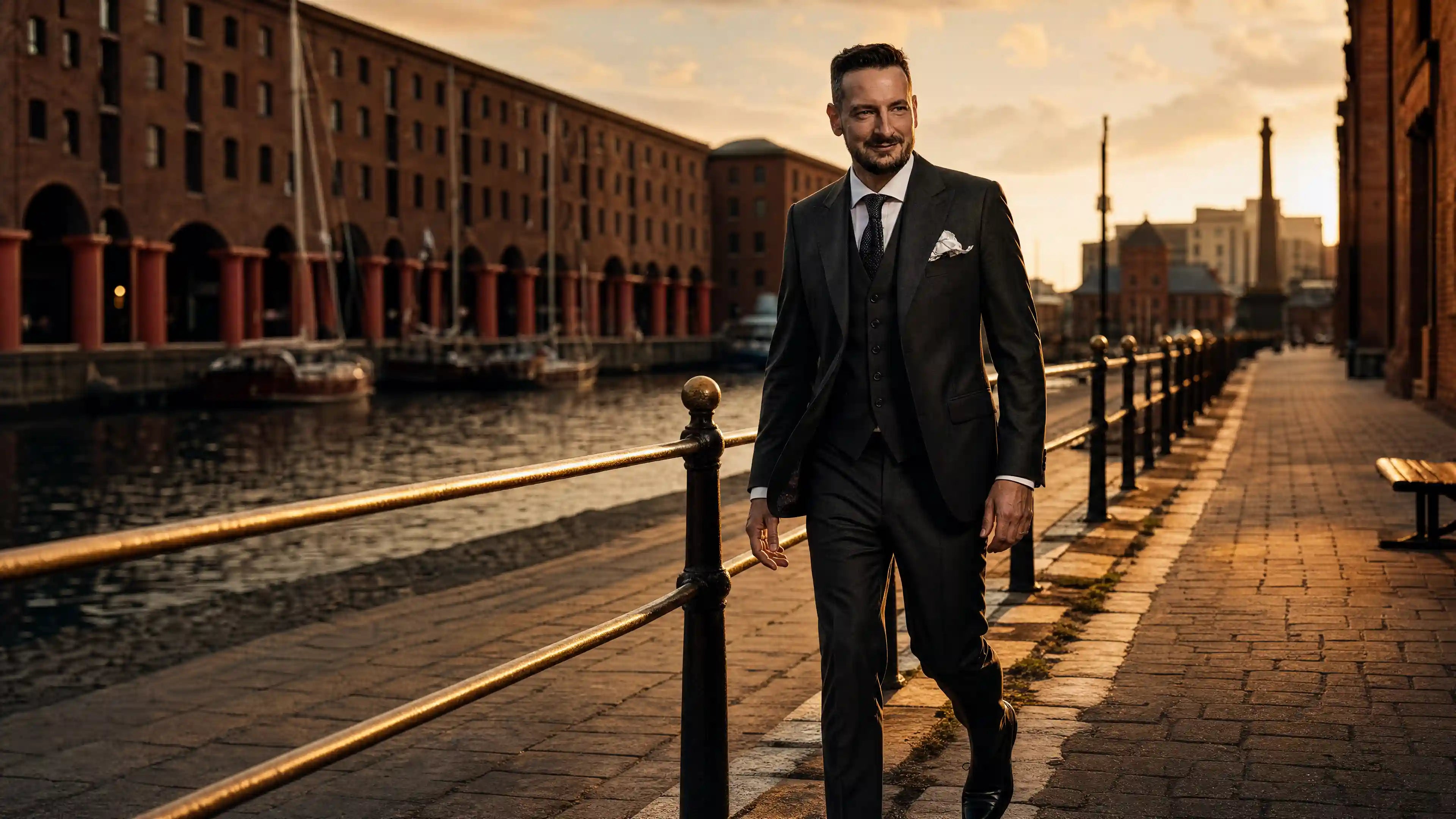
But I see clients privately, at your home, your office, or in my studios at the Royal Albert Dock in Liverpool or in Wadi Qortuba in Riyadh. No shop floor. No appointment desk. No queue behind a curtain. The work is the same standard as Savile Row because it is Savile Row construction, cut by someone trained in it, with the same mills' cloth books on the table in front of you.
For the men in the North West who used to fly to London four times for a single suit, I removed that friction. For the directors in Riyadh who'd given up on getting British bespoke locally, I brought it to KAFD.
The travel was never the point. The cut was.
The Practical Checklist: Seven Questions to Ask Any Tailor
Use these the next time someone tells you they make "bespoke" suits. The answers will tell you everything.
- Is the chest canvas floating or fused? (Fused is not bespoke. Full stop.)
- How many fittings are included? (Anything under three is made-to-measure, not bespoke.)
- Whose cloth do you use, and can I see the bunches? (If they can't name the mill, walk away.)
- Are the buttonholes hand-worked in silk? (Run your finger over them. You'll feel the irregularity.)
- Who cuts the pattern, and where? (A tailor who can't tell you this is selling someone else's work.)
- What is the lead time from first measurement to final suit? (Under 8 weeks is suspicious. 12 to 16 is honest.)
- Can I see a suit you cut three years ago for an existing client? (A real tailor has clients who'll show you.)
FAQ
How long does a bespoke suit take?
First measurement to final delivery: typically 10 to 14 weeks. Two to three fittings in between. I will not rush it. The hours are the hours.
Do I have to come to a studio?
No. I see clients at their home, their office, or in either studio: Royal Albert Dock in Liverpool, or Wadi Qortuba in Riyadh. Whichever removes friction from your week.
What's the price range?
A two-piece bespoke suit starts at £3,500 and rises with the cloth and the construction. A three-piece dinner suit in Holland & Sherry mohair is a different number. I'll quote precisely after the first conversation. There are no hidden costs.
Is bespoke worth it if I only wear suits occasionally?
Honestly? If you wear a suit twice a year, a good made-to-measure will serve you well. Bespoke earns its keep when the suit is doing work daily, weekly, in rooms where the cut matters. Tell me what you wear and how often, and I'll tell you the truth. or find more here : What to wear
Will it last longer than a high-street suit?
A floating canvas suit, treated properly (brushed, hung on a wooden hanger, dry cleaned no more than once a year) will outlast three or four high-street suits. Fifteen to twenty years is a realistic life. I have clients still wearing jackets I cut in 2014.
Can you match a suit I already own?
Sometimes. Bring it in. I'll tell you honestly whether the cloth is still milled or whether we're working from memory.
Do you work with grooms outside Liverpool?
Yes. Manchester, Cheshire, Wirral, Leeds, the wider North West. And in Riyadh, across Al Olaya, Al Nakheel, KAFD, and the surrounding districts. The studio is the meeting point, not the catchment.
What's the difference between bespoke and made-to-measure?
Made-to-measure adjusts a pre-existing block pattern to your measurements. Bespoke cuts a brand-new paper pattern from scratch, drafted to your body. One is alteration. The other is creation. The price difference reflects the difference in hours.
Why don't you have a shop?
Because the men I cut for don't want to be seen choosing cloth on a public floor. The work is private. It always has been.
A Final Word
I don't sell suits. I cut clothes for men whose presence carries consequence, and the suit is only the visible part of that work.
If you've read this far, you're not browsing. You're researching. That's the right way to start.
When you're ready, I'll put the kettle on, or the gahwa pot, depending on which studio, and we'll have the conversation. No appointment pressure. No pitch. Just a sit-down to find out what you actually need, and whether I'm the right cutter for it.
You can find me on Instagram @michael_frackowiak or through the journal at michaelfrackowiak.pro.
The conversation is the start. Everything else follows from there.
— Michael